春日
Angola to Play Peacemaker by Hosting DR Congo-Rwanda Meeting Amid Threats of War_我的网站

一 |
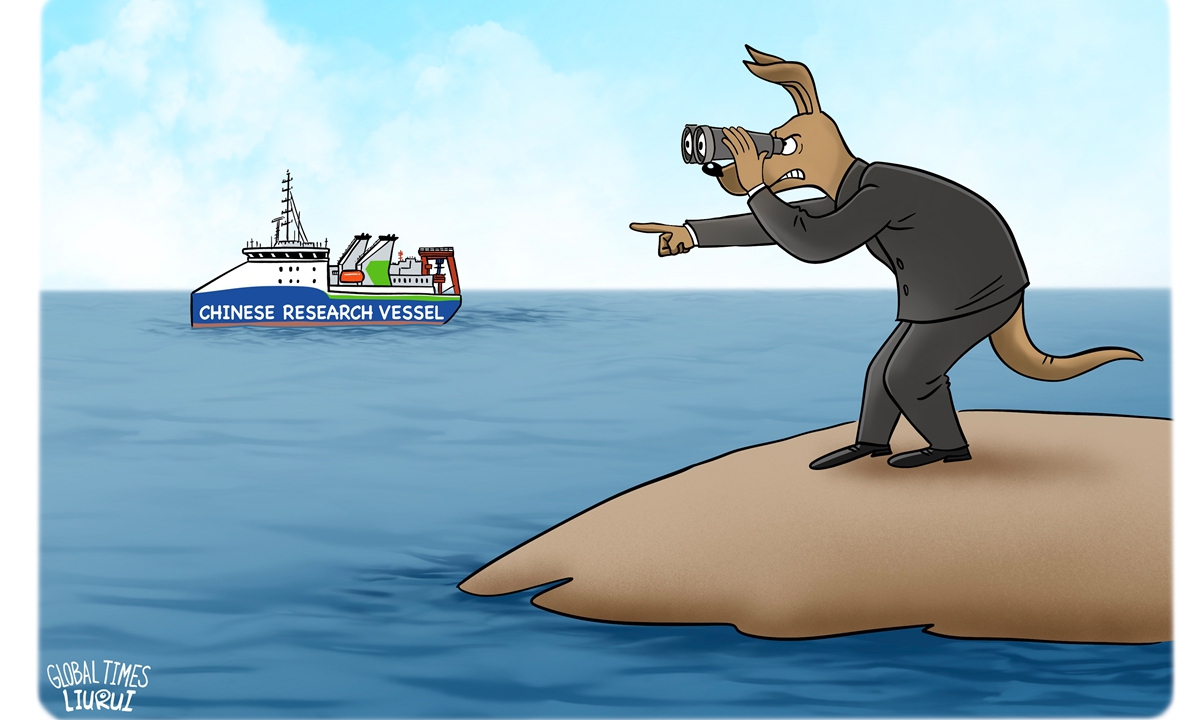
Illustration: Liu Rui/GTA new report funded by Australia's Department of Defense played up security risks to submarine cables in the Indo-Pacific waters and pointed finger at China and some other countries over alleged undersea‑cable attacks in recent years, while claiming threats against subsea cables are growing. A Chinese expert said that accusing China without conclusive evidence constitutes "over‑securitization" made by Australian side, as well as a calculated pretext for its own military expansion.
Published by the National Security College at the Australian National University (ANU), the paper claimed recent damage to cables in the Baltic Sea and around China's Taiwan region suggests "state actors are now actively probing and testing cable infrastructure in peacetime as part of broader hybrid warfare strategies" to rapidly degrade connectivity at the outset of a conflict, The Australian reported.
The paper claimed 16 privately owned subsea cables that carry 99 percent of Australia's internet traffic are a "high priority target" for Australia's adversaries that could be severed in a conflict, threatening the nation's economy and social fabric, according to The Australian.
The report singled out China and Russia for blame, saying that there have been multiple apparent attacks on submarine cables in recent years in European waters as well as near China's Taiwan region, suspected to be linked to Russia and China, the Straits Times reported.
However, the report cites a 2025 voyage by Chinese research vessel
Tan Suo Yi Hao along Australia's western and southern coastlines as evidence to back its claim that "potential adversaries are actively gathering information about Australia's cable infrastructure."
This report, relying on the routine scientific operations of a Chinese research vessel in 2025 to level allegations of offensive actions against China, and employing ambiguous terminology such as "suspected" and "potential," demonstrates Australia's evidentiary leap, Chen Hong, director of the Australian Studies Center of East China Normal University, told the Global Times on Monday.
This erroneous claim was refuted by the Chinese Foreign Ministry at the time. Chinese Foreign Ministry spokesperson Guo Jiakun said on March 31, 2025 that China carries out normal activities at sea in accordance with international law, including UNCLOS.
"We hope Australia will have a right understanding of this and stop the groundless suspicion and speculations," Guo added.
This is not the first time certain Australian politicians has leveled baseless accusations of China intending to sabotage its undersea cables. Back in May, Defense Minister Richard Marles claimed during the Shangri-La Dialogue that China ought to boost transparency around its maritime operations. He also asserted that a surge in damage to subsea cables had transformed the seabed into a "battlefield," per The Australian.
Chen said Australian side's scaremongering is tied to its predictive threat‑perception framework forged in recent years. This framework designates China and other countries as strategic competitors in advance, subsequently forces routine scientific activities into a confrontational framework, Chen said.
Apart from unfounded allegations against China, the paper claims Australia's defense military "must incorporate the defense of submarine cable infrastructure into its operational planning," according to The Australian.
It added the government should also consider up¬grading an auxiliary ship operated by the navy, ADV Guidance, to enable it to repair damaged cables.
The vast majority of submarine cable damages are caused by accidental factors such as fishing operations and vessel anchoring, rather than deliberate sabotage. For suspected cases of intentional damage, independent technical investigation bodies should be established, and the principle of "investigate first, characterize later" should be strictly applied, so as to prevent ordinary maritime accidents from escalating into diplomatic conflicts, Chen said.
The core problem of Australian side's submarine cable security lies entirely with itself. Instead of addressing its own infrastructure shortcomings and improving its domestic protection and maintenance systems, the Australian side has chosen to continually exaggerate external threats and stoke bloc confrontation, the expert added.
Chen said that by fabricating alleged Chinese threats, Australian side seeks to "rationalize" its military spending increases and underwater force expansion. The submarine digital infrastructure originally meant to serve global development has been labeled along us versus them lines, and this constitutes the biggest hidden danger, he added.
。 DRC President Felix Tshisekedi and his Rwandan counterpart, Paul Kagame, will travel to Luanda on Wednesday for talks, Patrick Muyaya, a spokesperson for Tshisekedi, told the Associated Press (AP) on Tuesday.,“They will be discussing Rwanda’s aggression in Congo,” Muyaya told the AP, adding it “is obvious” that Kinshasa still believes that Kigali has not just given the M23 rebel group its support, but has sent Rwandan soldiers to fight alongside them in eastern Congo’s North Kivu Province.,Kigali has denied both claims and levied similar ones at Kinshasa, saying they support the Hutu Power group Democratic Forces for the Liberation of Rwanda (FDLR), a militia in North Kivu descended from those who carried out the genocide of Rwandan Tutsis and Twa in 1994. In North Kivu, the FDLR and M23, a primarily Tutsi group, oppose each other.,“That is the same story for 20 years ago. Why would Congo be supporting them to shell Rwanda territory? Those accusations are not true,” Muyaya told AP. “We have to deal with hundreds of armed groups inside the country and we have been talking to all neighbors about a common strategy to end foreign armed group activities.”,© Paul EllisDemocratic Republic of Congo's President Felix Tshisekedi delivers his message during a session on Action on Forests and Land Use, during the UN Climate Change Conference COP26 in Glasgow, Scotland, Tuesday, Nov. 2, 2021.Democratic Republic of Congo's President Felix Tshisekedi delivers his message during a session on Action on Forests and Land Use, during the UN Climate Change Conference COP26 in Glasgow, Scotland, Tuesday, Nov. 2, 2021.© Paul Ellis,Lourenco has already established himself as a mediator in this dispute after securing the release of two Rwandan soldiers from Congolese custody in May. The soldiers had been taken from the Rwandan side of the border by the FDLR, according to Kagame’s government.,A previous conflict between Hutu and Tutsi groups in eastern Congo, in the aftermath of the 1994 genocide, led to the outbreak of the bloody Congo Wars, which drew in dozens of African nations and killed millions, mainly in DR Congo. The conflict is often referred to as “Africa’s World War” due to its destructiveness and scope.,In late June, the East African Community took action to try and calm tensions, voting to send troops to North Kivu to help keep the peace. A United Nations peacekeeping force has long been present in the area, with some 14,000 troops whose purpose is to keep different militia groups from fighting each other or brutalizing the local population.,The situation in North Kivu began to deteriorate last year after the M23, a group that disarmed in 2013, rebelled, claiming Kinshasa had not honored the terms of its demobilization. A series of infractions by both sides have turned up the tension, including the soldiers’ kidnappings, rockets flying across the border, and more.,© AP PhotoPresident Emmanuel Macron of France hosted Rwanda's President Kagame at the Elysee Palace last year as he sought to thaw relationsPresident Emmanuel Macron of France hosted Rwanda's President Kagame at the Elysee Palace last year as he sought to thaw relations© AP Photo,“If it wants war, it will have war,” Tshisekedi said of Rwanda late last month after M23 captured the city of Bunagana on the Rwandan border.,A separate incident earlier this week unfolded elsewhere in North Kivu. In the city of Beni, a Ugandan soldier “inadvertently shot … two of his comrades,” a spokesperson for the joint Congo-Uganda military mission there told reporters on Tuesday. He added that the soldier was under arrest.,Last month, Kampala and Kinshasa agreed to extend their six-month joint military operation in North Kivu for an unspecified period of time. The Ugandan military sent 1,700 troops into the area in December 2021 to help fight the Allied Democratic Forces (ADF), an Islamist rebel group that has long operated there but which in 2021 declared its allegiance to Daesh* and has been blamed for terrorist attacks in Kampala and across North Kivu. The group is of Ugandan origin but fled across the border into DR Congo in the 1990s.,*Daesh (also known as ISIS/ISIL/IS) is a terrorist organization banned in Russia and many other countries。
Current article:http://r9a1.yizhougengcuohei.cyou/news/20260826_9861577.html
Published on:00:00:00